
Scout Iran — All Whites' Must-Win Opener Odds & Preview
 Available in US
Loading...
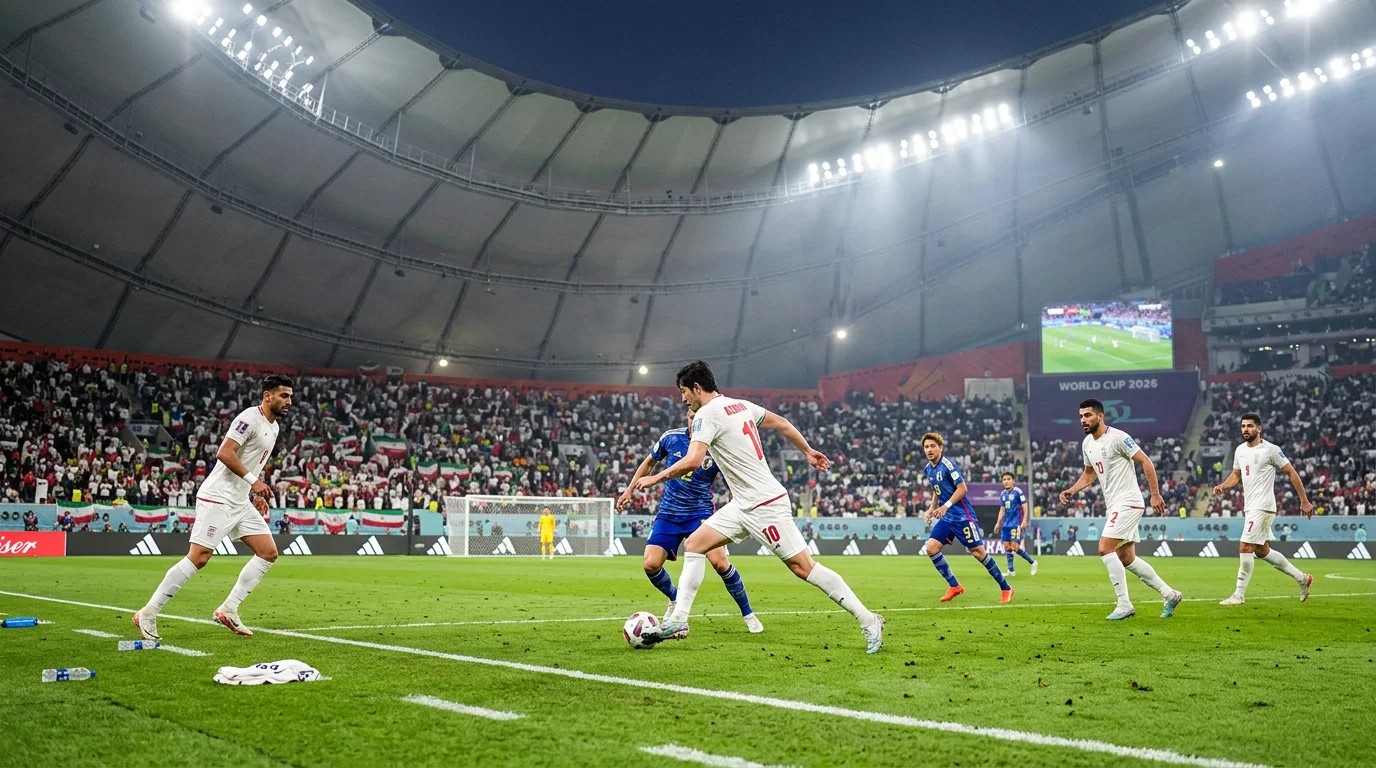
Ask any All Whites supporter which Group G match matters most and you will get the same answer before the question is finished: Iran. The opener on 16 June at SoFi Stadium in Los Angeles is not just the first match of New Zealand’s World Cup — it is the match that determines whether the next three weeks are a genuine campaign or an extended farewell. Beat Iran and the All Whites enter the Egypt and Belgium fixtures with points on the board, confidence in the system, and the belief that a third-place finish is within reach. Lose, and the mathematics of Group G become almost impossible to navigate. I have covered enough World Cups to know that opening matches carry disproportionate psychological weight — and for a team like New Zealand, playing at this level for the first time in 16 years, the psychological dimension is everything.
TL;DR: Iran Snapshot Plus Match 1 Preview
- Iran (Team Melli) have qualified for six of the last eight World Cups — the most experienced Asian side at this level.
- Disciplined, defensively organised, and dangerous from set pieces and counter-attacks. Iran do not beat themselves.
- Iran vs New Zealand on 16 June at 13:00 NZST, SoFi Stadium, Los Angeles — the All Whites’ tournament opener and the single most important fixture in their campaign.
- Key player: Mehdi Taremi, a clinical striker with experience at the highest levels of European club football.
- Our angle: this match is close to a coin-flip. The draw is the most probable single outcome at around 30 per cent. Back the draw at prices above 3.00 on TAB NZ — it offers the best risk-adjusted value in the entire Group G slate.
Trace Iran’s AFC Qualifying Path
Iran’s route to the World Cup ran through the Asian Football Confederation’s qualifying gauntlet — a multi-round process that began against lower-ranked opponents and culminated in a final group stage alongside Japan, Australia, Saudi Arabia, and other established Asian football nations. Team Melli finished in one of the direct qualification spots, and they did so with the kind of results profile that tells you exactly what to expect at the tournament: tight wins at home, disciplined draws away, and the occasional explosive attacking performance when the opponent left space to exploit.
The AFC qualifying numbers paint a portrait of a team that values defensive solidity above all else. Iran conceded fewer than a goal per match across the entire qualifying cycle, keeping clean sheets in more than half their fixtures. Their goals-against record was the best in the Asian confederation, and it was built on a system rather than individual brilliance — though the goalkeeping was excellent too. At the other end of the pitch, Iran averaged 1.5 goals per match, a modest but efficient return driven primarily by Mehdi Taremi’s finishing and the squad’s set-piece quality. Corners and free kicks accounted for nearly 40 per cent of Iran’s qualifying goals, a statistic that should alarm any opponent who struggles to defend dead-ball situations.
The qualifying campaign also revealed Iran’s limitations. Against Japan — the strongest team in the group — Iran lost both matches, unable to cope with the speed and technical quality of Japan’s pressing game. When forced to play on the front foot against an opponent that pressed high and denied time on the ball, Iran’s midfield became passive and the build-up stalled. That pattern is relevant for the All Whites: if New Zealand can impose an early physical presence and win the midfield battle, Iran’s composure under pressure is not guaranteed. Team Melli are most dangerous when they can absorb pressure and strike on the counter; they are most vulnerable when they are forced to create against opponents who refuse to commit numbers forward.
Assess the Squad and Tactical Identity
I spent a week in early 2026 watching Iranian football coverage to prepare for the Group G analysis, and the thing that struck me most was how well Team Melli’s players understand their roles. There is no confusion, no positional overlap, no wasted energy. Every player knows where to be in every phase of play — defensive shape, transition, possession, pressing — and executes with a mechanical precision that is almost unsettling. This is a squad that has been playing the same system, with minor variations, for the better part of a decade. The muscle memory is deep.
Mehdi Taremi is the attacking focal point. The forward has spent the peak years of his career in European football, first at Porto where he became one of the most efficient strikers in the Portuguese league, and subsequently at Inter Milan where he proved he could score and create at the very highest level. Taremi’s game is built on intelligent movement inside the penalty area — he finds the gaps between centre-backs, makes angled runs across the defensive line, and finishes with both feet and his head. His hold-up play allows Iran to play direct when the midfield is under pressure, and his willingness to drop deep and link play means he is involved in attacking phases even when he is not in the box. For New Zealand’s centre-backs, marking Taremi will require concentration for the full 90 minutes: he does not give defenders a moment’s rest, and a single lapse in focus is enough for him to find the space to shoot.
The midfield is Iran’s engine room. Saeid Ezatolahi or his successor in the holding role provides the defensive screen in front of the back four, breaking up attacks with well-timed tackles and distributing the ball simply to the wide players. The work rate of the Iranian central midfielders is exceptional — they cover enormous ground across 90 minutes, pressing in short, coordinated bursts before retreating into a compact shape. The wide midfielders are typically functional rather than creative, tasked with tracking back to form the second defensive line and supporting the full-backs when the opposition builds down the flanks. Iran do not rely on individual dribbling or skill in wide areas; they rely on collective pressing and quick, direct passing through the centre when the opportunity arises.
Defensively, Iran’s back four is experienced and well-drilled. The centre-backs are physical, dominant in the air, and comfortable defending deep in their own penalty area for extended periods. The full-backs tuck in to form a narrow defensive shape when the opponent has possession, making it difficult to play through the middle, and push wider when Iran have the ball to provide width in the build-up. The goalkeeper has been a consistent presence throughout the qualifying cycle, and his shot-stopping and penalty-area command give the defence confidence to hold their shape even when under sustained pressure.
The tactical identity can be summarised in a sentence: defend in a compact 4-5-1 or 4-4-1-1, win the ball back through collective pressing, and transition quickly into attack through Taremi. Iran will not dominate possession against anyone in Group G except possibly New Zealand; they will try to control the match through defensive shape and wait for the moments where the opposition’s concentration lapses. That approach makes them frustrating opponents who rarely lose by large margins — Iran’s World Cup history is littered with 1-0 defeats and goalless draws against superior sides, plus the occasional shock result (beating Morocco 1-0 in 2018, drawing with Nigeria in 2014) that shows they can compete at this level.
Break Down Iran’s Chances in Group G
Iran’s realistic objective in Group G is third place — a finish that, under the expanded 48-team format, could be enough to qualify for the Round of 32 as one of the eight best third-placed teams. To achieve that, Iran need to accumulate points against the opponents they can realistically beat or draw with: New Zealand and, potentially, a draw against Egypt. A defeat to Belgium is expected and will not derail the campaign as long as the other two results produce enough points.
The fixture sequence favours Iran in one important respect: they face New Zealand first, when both teams are at their most nervous and the pressure of a tournament opener amplifies every tactical error. Iran’s experience at this level — six World Cup appearances compared to New Zealand’s two — is a genuine advantage in the opening 20 minutes, when the crowd, the occasion, and the stakes can overwhelm less experienced squads. If Iran score first, the match dynamics shift decisively in their favour: they can retreat into their defensive shell, absorb pressure, and hit NZ on the counter. If the match is level after 30 minutes, the opening-match anxiety works against both teams equally, and the contest becomes a genuine toss-up.
Against Belgium on matchday two, Iran will deploy the same system they used against Japan in qualifying — the deepest defensive block in the Group G, with all 10 outfield players behind the ball when Belgium have possession. The plan is to survive: keep the score close, limit De Bruyne’s space to operate, and take any opportunities that arise from Belgian complacency. A 1-0 or 2-0 Belgium win is the most likely outcome, but Iran have the defensive discipline to keep the margin respectable and protect their goal difference for the third-place calculation.
The Egypt fixture on matchday three could be the most significant match in Group G outside of Belgium’s results. If both Iran and Egypt have taken three points each from their first two matches (beating NZ, losing to Belgium), the decider becomes a straight fight for second place. If either team has dropped points against NZ — a draw or, in Iran’s case, a defeat — the final matchday becomes about survival rather than advancement. The interdependence of Group G’s results means that punters should not assess any single match in isolation; every outcome affects the odds and dynamics of the subsequent fixtures.
Evaluate Iran’s Group G Odds
Iran’s outright World Cup winner odds are in the triple-digit range — purely speculative territory. Ignore that market entirely. The relevant markets for Iran are group-stage specific: to qualify from the group, to finish second, to finish third, and the individual match results.
To qualify from Group G (top two or best third) sits around 3.00 to 4.00 for Iran, implying a 25 to 33 per cent probability. My assessment is lower — around 20 to 28 per cent — because Iran’s path to qualification requires results against both NZ and Egypt, and the Egypt match is not one where Iran have a clear advantage. If you find Iran’s qualification price above 3.50, there may be marginal value, but it is not a strong enough edge to warrant significant stake.
The Iran vs New Zealand match result market is the most actionable. Iran win at around 2.30 to 2.60, draw at 3.00 to 3.30, NZ win at 3.20 to 3.80. This is a genuinely competitive fixture where the three-way market reflects real uncertainty. My probability estimates: Iran win 35 per cent, draw 30 per cent, NZ win 25 per cent, with the remaining 10 per cent covering extreme scenarios (red cards, injuries that distort the match). The draw at 3.20 is my preferred bet — it offers positive expected value against my estimated 30 per cent probability, and it reflects the most likely scoreline profile for a match between two defensively minded teams playing their first World Cup fixture in front of 70,000 people at SoFi Stadium.
For more adventurous punters, the under 2.5 goals market in Iran vs NZ is another strong play. Both teams prioritise defensive structure, both will be cautious in the opening match, and the combined goals-per-match average from their qualifying campaigns (Iran 1.5 scored, 0.8 conceded; NZ similar at OFC level, adjusted for quality) suggests a 0-0, 1-0, or 1-1 is far more probable than a 2-2 or 3-1 scoreline. Under 2.5 at prices around 1.65 to 1.80 is a solid, data-supported play.
Prepare for Iran vs All Whites — The Must-Win Opener
SoFi Stadium in Inglewood, Los Angeles. 16 June 2026. 13:00 NZST. The All Whites’ first World Cup match in 16 years, and the fixture that will define their entire tournament. I have built my preparation notes around three tactical phases that will determine the result.
Phase one: the first 15 minutes. Both teams will be tight, nervous, and reluctant to commit bodies forward. Iran’s game plan will involve probing New Zealand’s defensive shape with patient build-up, looking for gaps in the structure that can be exploited later in the match. The All Whites’ plan should be to establish a physical presence immediately — win the first header, contest every 50-50 ball, and show Iran that this is not going to be a comfortable afternoon. The team that wins the psychological battle in the opening quarter of an hour will carry that advantage through the rest of the match. New Zealand must not sit back passively; they need to impose themselves without overcommitting and leaving space for Taremi.
Phase two: the 25-to-60-minute window. This is where the match will be decided. Iran’s pressing intensity is highest in the first half, and their midfield will try to dominate the central areas by cutting off passes between NZ’s centre-backs and midfield. The All Whites’ response should be to bypass the midfield entirely with direct balls into Chris Wood, who can hold possession, draw fouls, and relieve pressure. Every free kick won in the Iran half is a potential scoring opportunity from Cacace’s delivery. If NZ reach half time at 0-0, the match transforms in their favour: Iran’s physical energy drops in the second half of matches (their qualifying data shows a decline in pressing actions after the 55th minute), and the space for NZ transitions increases as Iranian legs tire.
Phase three: the final 30 minutes. If the score is level, both teams face a decision: accept the draw or push for a winner. Iran’s instinct will be to accept the draw — a point against NZ is a solid start to the group. New Zealand’s situation is more complex: a draw is acceptable if the All Whites believe they can also take points off Egypt, but if the coaching staff assess that the Egypt match is likely a defeat, they may push for a winner against Iran in the final 20 minutes. That push introduces risk — gaps in the NZ defensive shape that Iran can exploit on the counter through Taremi. The smart approach is to accept the draw if it is available, take the point, and live to fight against Egypt in match two.
For punters watching live, the in-play markets in this match will be fascinating. If NZ are level at 60 minutes, the live draw price will have shortened significantly from its pre-match level, and the temptation to cash out or hedge becomes relevant. My advice: if you backed the draw pre-match at 3.20 or better, let it ride. The probability of the draw holding increases with every minute the match remains level, and the final 30 minutes of a tense, tactical contest between two defensive teams favour the draw more than either side’s win.
This is the match. This is where the All Whites’ World Cup 2026 is won or lost. Every punt, every prediction, every form-guide assessment in this entire guide converges on 90 minutes at SoFi Stadium. Back the draw. Watch the match. And be ready for the most important afternoon in New Zealand football since Polokwane 2010.
Team Melli’s Group G Arc
Iran draw 0-0 with New Zealand in a tense, tactically disciplined opener. Iran lose 2-0 to Belgium in their second match, unable to contain De Bruyne through the middle. Iran draw 1-1 with Egypt in the final group match, Taremi equalising from a penalty after a nervy first half. Iran finish third on two points, narrowly missing the best third-place cutoff due to an inferior goal difference compared to third-placed teams in other groups. Team Melli exit with dignity intact and a record that says they competed but were ultimately limited by the quality gap between their squad and Group G’s top two. For NZ punters, the key takeaway is that Iran are beatable — but only on a day when the All Whites match their discipline, their intensity, and their refusal to make mistakes. That is the challenge of 16 June.
