
Use Third-Place Rules — All Whites' Knockout Path
 Available in US
Loading...
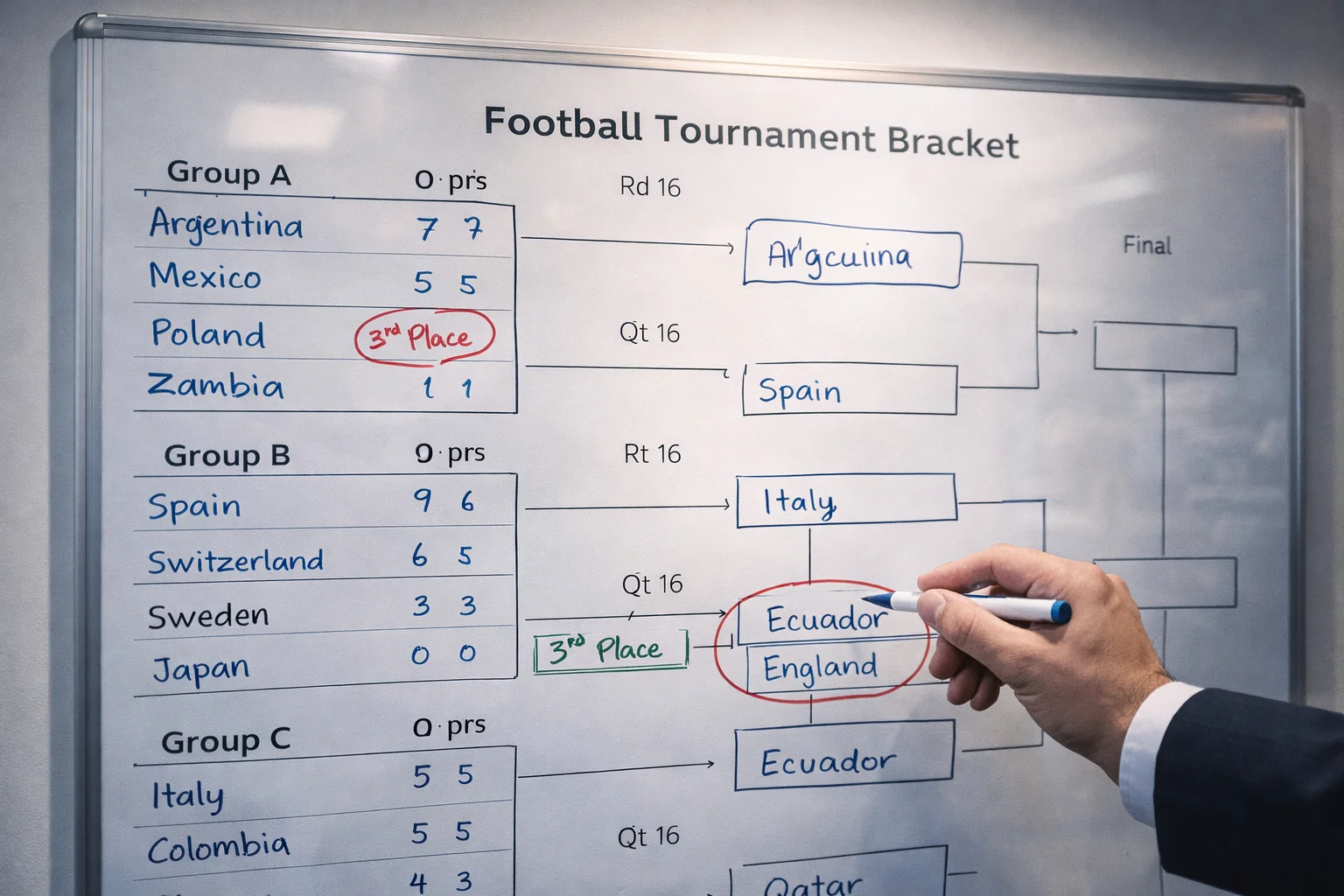
Three points in 2010 got New Zealand out of the World Cup. Three points might get them into the knockout rounds in 2026. The difference is format: FIFA’s 48-team expansion creates eight third-place qualification spots, meaning you don’t have to finish second in your group to keep playing. For the All Whites, this changes everything.
TL;DR — Points Thresholds and NZ Scenarios
- The magic number: Four points virtually guarantees advancement as a best third-place team. Three points with a positive goal difference is likely safe. Three points with a negative goal difference creates nail-biting scenarios.
- How eight spots are distributed: The eight best third-place teams across 12 groups advance to the Round of 32. Ranking criteria: points, then goal difference, then goals scored, then disciplinary record.
- NZ’s path: A win against Iran (3 points), a draw against Egypt (1 point) equals four points — advancement almost certain. Alternatively, three draws (3 points) with goal difference better than -2 probably advances.
- The realistic ceiling: Third place in Group G with 3-4 points, advancing to face a Pot 1 team in the Round of 32. That’s success — and it’s achievable.
Understand How Best Third-Place Qualification Works
The 2026 World Cup features 12 groups of four teams. Each group produces two automatic qualifiers (first and second place) and one potential qualifier (third place). Eight of those twelve third-place teams advance to the Round of 32. Four go home.
This system debuted at a World Cup in 1986 (24 teams, six groups, four third-place spots) and continued through 1994. The 1998 expansion to 32 teams eliminated third-place qualification by creating eight four-team groups where only the top two advanced. The 2026 expansion resurrects the concept at larger scale.
The ranking criteria for third-place teams follows standard FIFA tiebreakers. First, points earned in the group stage. A team with four points ranks above a team with three points, regardless of other factors. Second, goal difference. If two teams have three points each, the one with better goal difference advances. Third, goals scored. If goal difference is tied, more goals wins. Fourth, disciplinary record (fair play points based on cards received). Fifth, FIFA ranking at the draw date.
In practice, the disciplinary and ranking tiebreakers almost never matter. Points and goal difference resolve nearly all cases. The 1994 World Cup’s third-place cutoff was three points with a goal difference of -1. The 1990 cutoff was two points with goal difference of zero. Historical precedent suggests three points with neutral or positive goal difference is safe; fewer than three points is elimination.
The eight qualifying third-place teams are assigned to specific Round of 32 matchups based on their group letter. FIFA publishes bracket permutations showing which third-place teams face which group winners. Generally, third-place teams from Groups A-D face first-place teams from Groups E-H, and vice versa, but the exact assignments vary based on which specific groups produce qualifying third-place teams.
Calculate How Many Points a Third-Place Team Needs
Twelve groups produce twelve third-place teams. Eight advance. The mathematical floor is two points — it’s theoretically possible for eight teams to qualify with two points each if three groups produce third-place teams with only one point. But relying on theoretical minimums is a path to disappointment.
Simulations based on historical World Cup scoring patterns and expanded-format projections suggest the following probability bands:
Four points or more: 95%+ chance of advancement. Only extreme tiebreaker scenarios involving multiple four-point third-place teams eliminate anyone at this threshold. For practical purposes, four points is safe.
Three points, goal difference +1 or better: 85-90% chance of advancement. You’re likely among the top eight third-place finishers. Edge cases involving many three-point teams with positive goal difference could create elimination, but it’s rare.
Three points, goal difference 0: 70-80% chance of advancement. You’re on the bubble. Other groups’ results matter significantly. A tournament where many group stages produce decisive results (clear first and second finishers, weak third-place teams) is favourable. A tournament with tight groups everywhere is dangerous.
Three points, goal difference -1 to -2: 50-65% chance of advancement. Nail-biting territory. You need other third-place teams to underperform. The final matchday results across all groups determine your fate.
Three points, goal difference -3 or worse: 30-45% chance of advancement. Likely elimination unless multiple groups produce weak third-place finishers. At this threshold, you’re hoping for help rather than controlling your destiny.
Two points: 15-25% chance of advancement. Requires significant failures elsewhere. Historically possible but statistically unlikely. Plan as if two points means going home.
The takeaway: target four points. Achieve three points with positive goal difference as a fallback. Anything less depends on circumstances you can’t control.
Map the All Whites’ Path — What Results Are Needed
Group G pairs New Zealand with Belgium, Egypt, and Iran. Belgium is the clear favourite; Egypt is solid; Iran is competitive. New Zealand enters as the fourth seed based on FIFA ranking. The path to third place — and advancement through third-place qualification — runs through specific match results.
Scenario one: Win against Iran, draw against Egypt, lose to Belgium. This produces four points with a likely goal difference of 0 to +1 (depending on margins). Four points virtually guarantees Round of 32 qualification. This is the target scenario.
Iran opens Group G against New Zealand on June 15 (June 16 NZST). A win here is the foundation of everything. Iran is beatable — they qualified through AFC, have quality in midfield, but lack creative attacking options. New Zealand’s defensive organisation can frustrate them. Chris Wood provides a focal point for set pieces. A 1-0 or 2-1 win is plausible.
Egypt follows on June 21 (June 22 NZST). Mohamed Salah makes Egypt dangerous, but they’re not unbeatable. A 0-0 or 1-1 draw adds one point without damaging goal difference. New Zealand’s approach should be pragmatic: don’t lose, don’t chase a win recklessly. A point against Egypt combined with victory over Iran equals four points before the Belgium match.
Belgium closes the group on June 26 (June 27 NZST). If New Zealand already has four points, this match becomes academic for advancement purposes. Belgium will likely field a strong side regardless (goal difference matters for knockout seeding), but New Zealand can prioritise not getting hammered. A 2-0 loss with four points already banked is fine. A 5-0 loss damages goal difference but probably still advances.
Scenario two: Draw all three matches. This produces three points with a goal difference of 0. Based on probability estimates above, three points with neutral goal difference advances 70-80% of the time. Not ideal, but workable.
Drawing Belgium sounds optimistic, but Belgium’s golden generation is ageing. Kevin De Bruyne, Romelu Lukaku, and Thibaut Courtois are past peak. A disciplined New Zealand side playing for a point could frustrate them. Iran-style pragmatism (compact shape, quick transitions, dead-ball threat from Wood) isn’t sexy but keeps scorelines tight.
Drawing Egypt and Iran is achievable without heroics. Neither side is dramatically superior to New Zealand. A tournament where the All Whites grind out three 1-1 draws isn’t glamorous, but it might be enough.
Scenario three: Beat Iran, lose to Egypt and Belgium. This produces three points with goal difference dependent on margins. If both losses are by one goal (1-0, 2-1), goal difference is -1 to -2, and advancement probability is 50-65%. If either loss is heavy (3-0, 4-1), goal difference craters and advancement becomes unlikely.
The defensive task in losses matters. Losing 2-1 to Egypt is far better than losing 3-0 for third-place calculations. Every conceded goal erodes standing. New Zealand should play to win when possible, play to draw when necessary, and play to limit damage when outclassed.
Learn From Third-Place Teams at Past World Cups
History provides templates for third-place survival. The 1994 World Cup — the last to use third-place qualification at a World Cup — saw Belgium, Argentina, and Italy all advance with four points from their groups. The cutoff was three points with goal difference of -1 (Romania). Teams with two points (Russia, Cameroon, South Korea) went home.
The Euro 2016 format closely mirrors what the All Whites face. Twenty-four teams in six groups, with four third-place teams advancing. The cutoff that tournament was three points with goal difference of -2 (Northern Ireland, who advanced despite losing their final group match). Portugal, the eventual champion, finished third in their group with three points and goal difference of 0 — they advanced as a third-place team and won the entire tournament.
The lesson from Portugal: third-place qualification isn’t a death sentence. It’s a path. Teams that advance through third place often face difficult Round of 16 opponents, but they’re still alive. Portugal beat Croatia in extra time, then Poland on penalties, then Wales, then France. The journey began with third-place qualification.
For New Zealand, the parallel is encouraging. Third place in Group G likely means facing a group winner from the other half of the bracket — possibly Spain, Germany, or Netherlands depending on permutations. Tough draws, but not impossible. The All Whites in 2010 drew Italy 1-1. Upsets happen. Being in the tournament is the prerequisite for glory; third-place qualification provides that prerequisite.
The 2026 bracket structure creates additional nuance. Third-place teams are assigned to specific Round of 32 matchups based on which groups produce qualifying third-place finishers. If all four “easier” groups (say, Groups A, B, C, D) produce qualifying third-place teams, those teams face Group E-H winners. If the distribution differs, assignments shift. New Zealand can’t control this — they can only control finishing with enough points to qualify regardless of which slot they’re assigned.
What This Means for Betting Markets
Third-place qualification creates value in betting markets that operators underappreciate. The “New Zealand to qualify from Group G” market prices the All Whites at longshot odds, but those odds often conflate “top two” with “qualify.” If TAB NZ offers “New Zealand to advance to knockout rounds” separately from “New Zealand to finish top two in Group G,” the former offers better value.
The goal-difference implications matter for total goals markets. New Zealand has incentive to keep matches tight even in losses — a 1-0 loss to Belgium is infinitely better than a 4-0 loss for third-place calculations. This suggests Under markets in All Whites matches might carry hidden value. The team won’t chase goals recklessly; they’ll protect goal difference.
For match betting, the Iran opener becomes critical. A New Zealand win in that match fundamentally changes their tournament trajectory. If you’re bullish on the All Whites — and the guaranteed OFC qualification spot justifies some bullishness — the Iran match offers the best risk-adjusted opportunity. New Zealand at 3.50-4.00 to beat Iran is plausible value if you believe in their defensive organisation.
The broader strategic takeaway: third-place qualification adds uncertainty that operators don’t always price correctly. “Will New Zealand qualify?” is a simpler question than “Will New Zealand finish in the top two?” but most operators don’t unbundle those outcomes. Finding operators who do — or exploiting correlated markets — creates edge.
The Realistic Assessment
New Zealand qualifying for the Round of 32 through third place is genuinely achievable. It requires beating Iran, managing Egypt, and not getting destroyed by Belgium. Four points is the target. Three points with positive goal difference is the fallback. Three points with negative goal difference is the sweat.
The All Whites won’t win the World Cup. They probably won’t reach the quarter-finals. But they can be one of eight third-place teams who advance, extending their tournament by at least one match and generating the kind of national attention that transforms a sport’s profile. That’s the prize — and the third-place qualification rules make it possible.
For a complete breakdown of the Group G matchups and betting angles across all three matches, the Group G preview covers the All Whites’ path in exhaustive tactical detail.
