
Assess Germany at World Cup 2026 — Odds & Group E Guide
 Available in US
Loading...
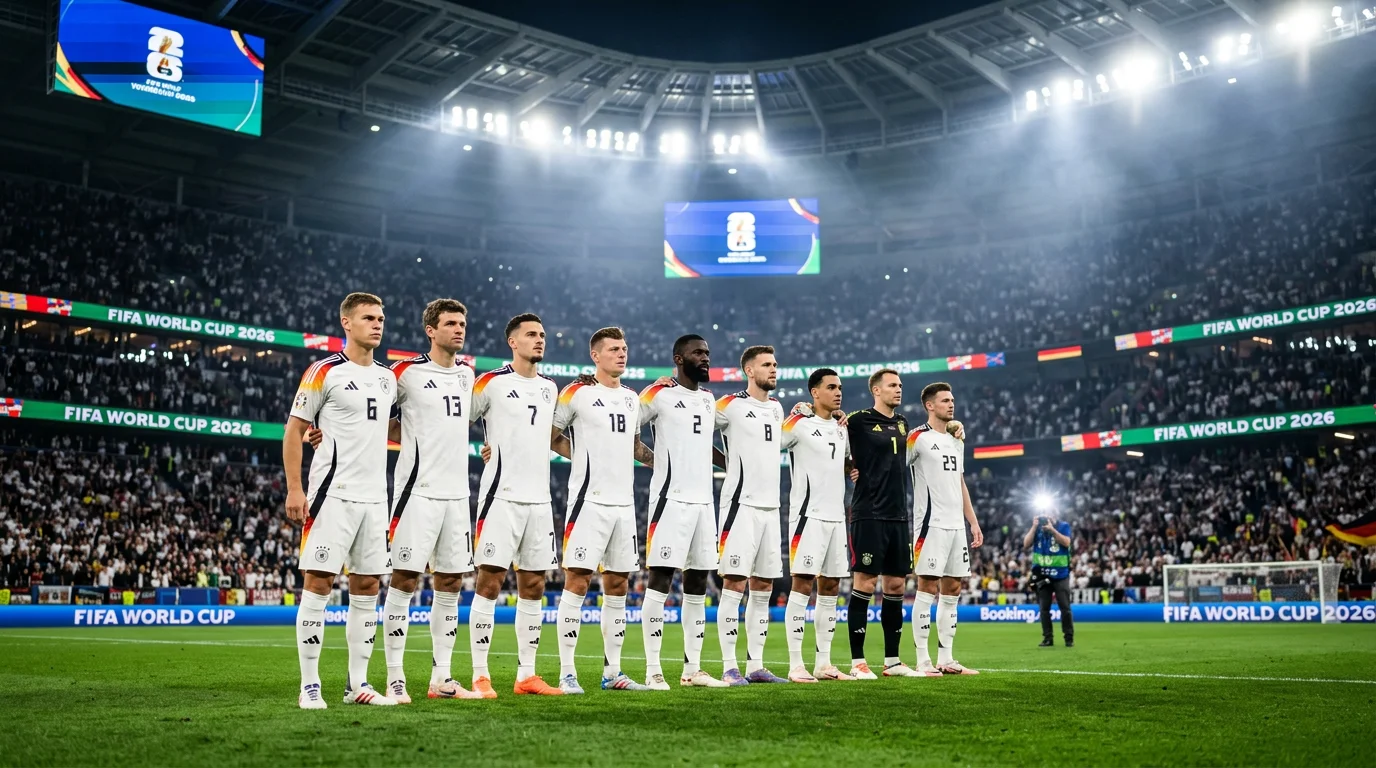
Germany’s World Cup story over the past decade reads like a Greek tragedy compressed into three acts. Act one: triumph in Brazil, 2014, the 7-1 demolition of the hosts, the Götze goal in the final, a fourth star on the jersey. Act two: humiliation in Russia, 2018, last place in a group they were expected to win, the defending champion curse in its most brutal form. Act three: disappointment at home, Euro 2024, a tournament where the revival seemed real until Spain ended it in the quarter-finals with a 117th-minute winner. Now comes act four, and the question hovering over German football is whether this is a renaissance or a false dawn. Die Mannschaft arrive at the 2026 World Cup with a squad younger and faster than the 2018 or 2022 vintages, a coaching setup rebuilt after the Euro 2024 campaign, and a Group E draw — Curacao, Cote d’Ivoire, Ecuador — that offers a comfortable path to the knockout rounds. The talent is undeniable. The trauma of recent tournaments is equally real.
TL;DR: Germany Betting Snapshot
- Four-time champions but winless since 2014 — two consecutive group-stage exits in 2018 and 2022 shattered the aura of German tournament football.
- Group E opponents: Curacao, Cote d’Ivoire, Ecuador. Germany should qualify without distress.
- Florian Wirtz and Jamal Musiala lead a generational shift that makes this squad quicker and more creative than any German team in a decade.
- Outright odds around 10.00 to 14.00 — mid-tier contenders, behind Argentina, France, Brazil, and England.
- Our angle: Germany’s value is in the outright at prices above 12.00, where the market underrates the generational talent in midfield and the improvement in the squad since 2022. The to-reach-the-quarter-finals market at around 1.80 is the safer play.
Review Germany’s Qualifying Run
After the Euro 2024 quarter-final exit on home soil, Germany faced the uncomfortable reality that their automatic place in the next tournament was not guaranteed — they still had to qualify through the UEFA pathway like everyone else. The qualifying campaign began under a cloud of public scepticism, but the results quickly silenced the doubters. Germany topped their group with a record that read: eight wins, one draw, one defeat across 10 matches, 30 goals scored and eight conceded. The sole defeat came away to a well-organised Turkish side in Istanbul — a match that, tellingly, Germany dominated in possession and chances but lost through a counter-attacking goal in stoppage time.
The qualifying data tells an encouraging story for German football. The squad’s expected goals numbers were the second-highest in European qualifying behind only France, and the defensive structure showed marked improvement from the porous setup that collapsed in the 2022 group stage. The new coaching staff implemented a higher defensive line than Germany had used in years, betting on the pace of the centre-backs and the pressing intensity of the midfield to win the ball back before opponents could exploit the space behind. The gamble paid off: Germany’s high press forced turnovers in the opposition half more frequently than any other European qualifier, creating high-quality chances from direct transitions.
For betting purposes, the qualifying campaign establishes Germany as a side that creates chances at volume and converts at a good rate. Their weakness — defensive vulnerability against quick, direct opponents — is noted, but the improvement from the 2022 baseline is significant enough to warrant a reassessment of the squad’s tournament ceiling. Germany in 2026 are not the side that lost to Japan and South Korea in consecutive World Cups; they are a younger, more dynamic team with a system that suits the talent at their disposal.
Assess the Squad and the Generational Shift
The 2014 generation is gone. Müller, Kroos, Neuer — all retired from international football. What replaces them is a midfield that might, player for player, be the most talented in the tournament. Florian Wirtz and Jamal Musiala are the headline names, and for good reason: at 23 and 22 respectively, they represent a creative partnership that Germany have not possessed since Özil and Müller were at their peak.
Wirtz’s game is built on intelligence and precision. He finds space in congested areas of the pitch with an ease that belies his age, receives the ball on the half-turn, and plays final-third passes that dissect organised defences. His finishing from the edge of the penalty area has improved dramatically over the past two seasons at Bayer Leverkusen, where he was central to their Bundesliga title campaign. Wirtz does not have the explosive acceleration of a Mbappe or the direct dribbling ability of a Vinicius Junior — his weapon is the perfectly weighted through ball that arrives in space behind the defensive line exactly as a teammate makes the run. Against Group E opponents who will sit deep, that ability to play the killer pass is the most valuable attacking attribute in the squad.
Musiala complements Wirtz with qualities that are almost opposite in style but equally devastating in effect. Where Wirtz is surgical, Musiala is chaotic — in the best possible sense. His close control in tight spaces, his ability to wriggle past two or three defenders in the penalty area, and his capacity to create chances from nothing make him the squad’s most unpredictable attacking threat. Musiala at Bayern Munich has developed into a player who can produce match-winning moments against any defence in the world, and his tournament record — he was Germany’s standout performer at Euro 2024 — suggests the big-stage temperament is already in place.
The centre-forward position has been addressed more convincingly than at any point in the past five years. Whether the coach opts for a traditional striker or a false-nine system with Musiala or Kai Havertz dropping deeper, the attacking structure generates enough chances to score three or four goals against weaker opponents. The defensive midfield role — anchored by a player who screens the back four while Wirtz and Musiala push forward — is the tactical pivot. Robert Andrich or a comparable profile provides the disciplinary framework that allows the creative players their freedom without leaving the defence exposed.
Defensively, the centre-back pairing is the squad’s most obvious question mark. Antonio Rudiger’s experience at Real Madrid provides a world-class anchor, but the second centre-back position has been rotated throughout the qualifying cycle without a clear first-choice emerging. The full-backs — typically overlapping in attack and potentially vulnerable in transition — have been a recurring concern. Germany’s system demands that full-backs push high to provide width, but the pace to recover when the opposition counters is not always there. Against faster Group E opponents like Cote d’Ivoire, the space behind the full-backs could be exploited if Germany overcommit.
Marc-Andre ter Stegen in goal, if fit, provides elite goalkeeping that stabilises the entire defensive unit. His distribution under pressure is among the best in the world, allowing Germany to play out from the back even when opponents press high, and his shot-stopping has become more consistent in recent seasons. The goalkeeper position is one area where Germany are genuinely world-class, and ter Stegen’s presence raises the defensive floor of the entire team.
Break Down Group E — Curacao, Cote d’Ivoire, Ecuador
Group E is manageable for Germany but not without interest. The fixture list reads: Curacao (the minnows), Cote d’Ivoire (the Africa Cup of Nations holders), and Ecuador (a consistent South American qualifier). Germany should top the group, but the manner in which they do so will tell us a great deal about their knockout-round readiness.
Curacao are the tournament’s smallest nation by population and one of the lowest-ranked teams in the draw. Their qualification through the CONCACAF pathway was a fairytale achievement for an island of 150,000 people, and the squad is composed entirely of players from the Dutch lower divisions and Caribbean leagues. The quality gap between Curacao and Germany is the widest of any group-stage matchup at the tournament. Germany should win this match by five or six goals, and the over/under and margin-of-victory markets are far more interesting than the match result itself. If you are backing a German player for the Golden Boot, the Curacao fixture is the match that pads the goal tally.
Cote d’Ivoire are the group’s most dangerous opponent. The Elephants won the Africa Cup of Nations in 2024 on home soil, and the squad blends Premier League and Ligue 1 talent across every position. Seko Fofana’s midfield driving runs, Nicolas Pépé’s pace on the wing, and a defensive unit that handled the pressure of a home tournament without cracking make Ivory Coast a team that can compete with anyone on their day. Against Germany, Cote d’Ivoire will attempt to match the press and compete in midfield — a bold approach that could produce an open, entertaining match. Germany’s superior individual quality should prevail, but a 2-1 or 2-2 result is within the range of outcomes if the Ivorian press disrupts Germany’s build-up in the first half.
Ecuador are experienced World Cup campaigners who qualified through the CONMEBOL pathway — the same brutal 18-match qualifying cycle that Argentina and Brazil navigated. Ecuador’s squad is compact and well-coached, built around a high-energy pressing game and quick vertical transitions through the centre of the pitch. Moises Caicedo, the Chelsea defensive midfielder, is Ecuador’s most important player: his ability to break up attacks and launch counter-attacks in a single motion makes him the tactical linchpin. Germany versus Ecuador is a contest between German creativity and Ecuadorian intensity, and the outcome will likely depend on which team’s midfield imposes its rhythm first. A Germany win at 1-0 or 2-1 is the most probable result, but Ecuador are capable of causing an upset if they score first and force Germany to chase the game.
For punters, Germany to top Group E is fairly priced at around 1.50 to 1.70. The total group goals for Germany over/under line will be set around 8.5, and the over is attractive given the Curacao fixture. The Cote d’Ivoire match is the best single-game betting opportunity in the group — the match result is genuinely uncertain, and the odds on a draw or Ivorian upset could offer value if you believe their AFCON-winning pedigree translates to World Cup level.
Evaluate Germany’s Odds — Group and Outright
Germany’s outright World Cup winner odds on TAB NZ sit around 10.00 to 14.00, placing them in a tier below Argentina, France, and Brazil but ahead of the Netherlands, Spain, and Portugal. Those odds imply a win probability of 7 to 10 per cent. My assessment is slightly higher — around 8 to 12 per cent — because the market has not fully recalibrated for the generational shift in the squad. The Germany that lost in the group stage in 2018 and 2022 was an ageing, slow, tactically rigid side. The Germany of 2026 is young, fast, and creatively gifted through the middle. The market remembers the failures; it has not yet priced the transformation.
At odds above 12.00, Germany’s outright represents a genuine value play. The squad’s ceiling — Wirtz and Musiala combining at their best, the defence holding firm, the press functioning at Euro 2024 levels — is a World Cup semi-final or final. The floor — defensive collapses, a group-stage wobble against Ecuador or Cote d’Ivoire — is a quarter-final exit. That range of outcomes, weighted toward the upper end given the qualifying data and squad quality, justifies a moderate outright stake at long odds.
The “to reach the quarter-finals” market at around 1.80 to 2.00 is the safer alternative. Germany’s group draw and the likely knockout bracket — facing a second-placed team from Group F (Japan or Sweden) in the Round of 16, then a potential quarter-final against a Group G or H winner — are navigable. Germany reaching the last eight requires them to win four matches against beatable opposition, which the squad quality supports. This market captures Germany’s likely deep run without requiring them to overcome the very best teams in the tournament.
Player markets are worth exploring. Wirtz or Musiala for the Young Player Award (if eligible by age) could offer speculative value. Germany’s total tournament goals, if set around 11.5 or 12.5, favours the over given the Curacao fixture and the attacking firepower available. A Wirtz or Musiala anytime goalscorer multi across two group matches is another angle — both players will have significant goal involvement against weaker group opponents.
Find Betting Value on Die Mannschaft
My three Germany plays for the 2026 World Cup target different risk levels. The conservative play is Germany to reach the quarter-finals at 1.80 — high probability, moderate return, suitable as a multi leg. The moderate play is Germany outright at 12.00 or longer — a squad this talented at this price is a mispricing that could correct once the group stage demonstrates their quality. The aggressive play is Germany’s total group goals over 8.5 — the Curacao fixture alone could produce five or six, and if Germany also score two or three against Ecuador and Cote d’Ivoire, the over hits comfortably.
What I am avoiding: any market that requires Germany to beat Argentina or France in a knockout match. Germany’s defensive vulnerabilities — the space behind the full-backs, the occasional centre-back errors — are exploitable by elite counter-attacking teams. Wirtz and Musiala can create against anyone, but if the defence concedes two goals, the creative midfield has to score three, and that equation does not favour Germany against the very best. Back Germany to go deep. Do not back them to win the tournament unless the odds drift beyond 15.00, at which point the price compensates for the defensive risk.
Die Mannschaft’s North American Campaign
Germany top Group E with seven points after beating Curacao emphatically, edging Cote d’Ivoire in a competitive match, and drawing with Ecuador in a rotated lineup. The Round of 32 is comfortable. The Round of 16 produces a tense match against a well-organised European or Asian opponent, which Germany win through a Musiala moment of individual brilliance. The quarter-final is the end of the road — a match against a genuine contender (Spain, Belgium, or the Netherlands) where Germany compete for 80 minutes before a defensive error costs them a goal they cannot recover from. A quarter-final exit, promising but ultimately insufficient — the fifth act of German football’s post-2014 drama, with the final chapter still unwritten.
