
Back France at World Cup 2026 — Odds, Squad & Value
 Available in US
Loading...
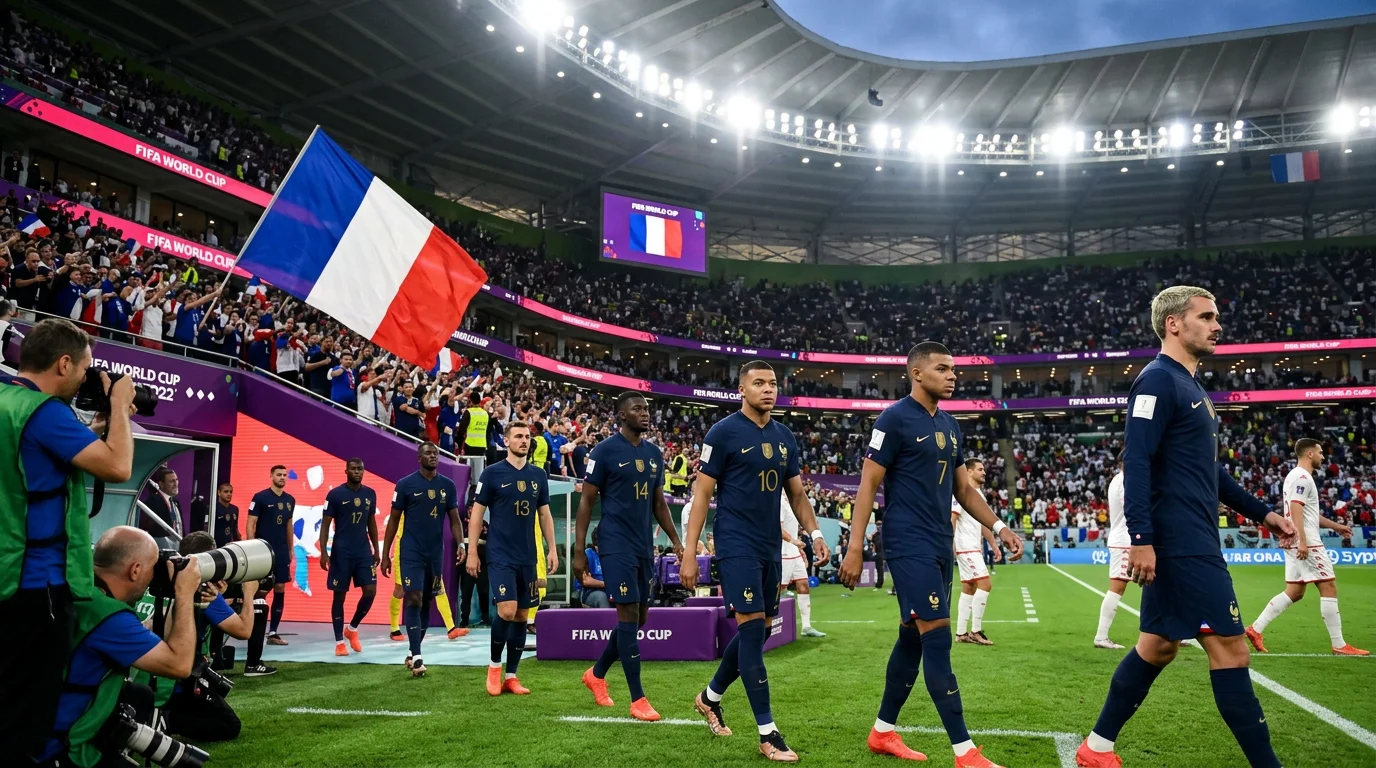
Two finals in the last three World Cups. One trophy. One agonising penalty-shootout defeat. France do not just compete at tournaments — they haunt them. Since Didier Deschamps took charge in 2012, Les Bleus have reached a minimum of the quarter-finals at every major competition they have entered, a streak of consistency that no other nation in world football can match over the same period. The 2026 World Cup is Deschamps’ last dance too. He has confirmed this will be his final tournament, which adds a layer of personal narrative to a squad already overflowing with motivation. Kylian Mbappe, now fully established as the most feared forward in the game, leads a generation of French players who believe they are destined to add a third star to the jersey. Group I — Senegal, Iraq, Norway — will not slow them down. The question is what happens when the knockout rounds begin and the margins compress to almost nothing.
For NZ punters on TAB NZ, France are typically priced as joint-favourites or close behind Argentina. Whether that price represents value or a trap depends on how you weigh Mbappe’s individual brilliance against the system’s occasional brittleness. I will walk you through both sides.
TL;DR: France Betting Snapshot
- Two-time champions (1998, 2018) and 2022 runners-up — the most consistent knockout-round team of the modern era.
- Group I opponents: Senegal, Iraq, Norway. France should top the group without breaking stride.
- Mbappe is the tournament’s most likely top scorer and the centrepiece of every French attack.
- Outright odds sit around 5.50 to 7.00 — competitive with Argentina and Brazil.
- Our angle: France’s floor is higher than any other team. The “to reach the semi-finals” market at around 1.70 to 2.00 is the safest high-probability play in the outright-adjacent markets.
Review France’s Campaign
You would think qualifying from UEFA would be straightforward for a team of France’s calibre, and you would be mostly right — but not entirely. The European qualification pathway threw up a few awkward moments that revealed cracks in the squad’s depth and defensive concentration. France dropped points away to Greece in a match where the defence switched off from set pieces, and a goalless draw against Ukraine in Kyiv exposed a lack of creativity when Mbappe was injured and unavailable. Those hiccups mattered less for qualification — France still topped their group comfortably — and more for what they told us about the squad’s vulnerabilities.
The headline stat from qualifying is that France scored the most goals of any European team in the campaign: 28 across 10 matches, an average of 2.8 per game. Mbappe accounted for a third of those directly and assisted on several more. The reliance on a single player’s output is both France’s greatest strength and their greatest risk. When Mbappe is firing — when he is beating full-backs for pace, cutting inside to shoot with either foot, and linking with the attacking midfielders in tight combinations — France are unstoppable. When he is marked out of the game, as Croatia managed in the 2022 group stage and the Netherlands achieved at Euro 2024, France lack a consistent alternative source of goals.
Deschamps used the qualifying cycle to experiment with different midfield combinations and defensive setups, settling on a 4-3-3 as the base system with flexibility to shift to a 4-2-3-1 in bigger matches where midfield control is paramount. The defensive record was strong: nine goals conceded in 10 matches, with Alisson-like distribution from Mike Maignan in goal enabling France to play out from the back under pressure. The qualifying data supports the view that France are a top-three team in the tournament, fully capable of beating anyone on their day, but slightly more vulnerable than their odds imply when the game’s rhythm does not suit Mbappe’s counter-attacking instincts.
Assess the Squad — Mbappe, Midfield Engine and Depth
Mbappe at 27 is the closest thing in world football to a guaranteed goal threat. His pace — still elite even as he has added muscle and upper-body strength over the past two seasons at Real Madrid — means defences cannot push their line high against France without risking being exposed in behind. His movement off the ball has matured; where the younger Mbappe ran in straight lines, the 2026 version makes darting diagonal runs across the face of centre-backs, peeling into the half-space between full-back and centre-half to receive through balls. His finishing in one-on-one situations against the goalkeeper is among the best in history: the composure, the variety of technique (chips, placed shots, power strikes), and the ability to finish on both feet make him a nightmare for any defence in the tournament.
The question with Mbappe has never been his quality — it has been whether France can create enough for him. At Real Madrid, the supply line comes from Vinicius Junior, Jude Bellingham, and the full-backs. With France, the supply depends on the midfield, and here Deschamps has a decision that will define the tournament. Aurélien Tchouaméni and Eduardo Camavinga form the most athletic midfield pairing in international football — both are capable of covering enormous ground, winning tackles, and driving forward with the ball. What they sometimes lack is the final-third creativity to unlock deep defences. Antoine Griezmann, at 35, may no longer start every match but remains the most intelligent passer in the squad, capable of finding the through ball that releases Mbappe in behind. Whether Deschamps starts Griezmann in a deeper role or brings him on as an impact sub is one of the key tactical questions heading into the tournament.
The wide positions offer Deschamps options that most coaches can only dream about. Ousmane Dembele’s dribbling ability and willingness to take on defenders in one-on-one situations provides a different attacking threat to Mbappe — where Mbappe makes runs in behind, Dembele engages defenders face-to-face and creates chaos in the defensive structure. Randal Kolo Muani offers a more direct, physical presence that can hold the ball up and bring others into play. The ability to rotate these attacking options across group matches — and tailor the lineup to specific opponents in the knockouts — is a significant squad advantage.
Defensively, France’s centre-back pairing of Dayot Upamecano and William Saliba has developed into one of the most reliable in European football. Saliba’s composure on the ball and reading of the game provides the platform, while Upamecano’s pace and aggression handle the physical battles. The full-backs — Theo Hernandez on the left, Jules Kounde on the right — are attack-minded by nature, which creates both opportunities and risks. When both full-backs push high simultaneously, the space behind them becomes vulnerable to quick transitions, and Deschamps has not always solved this problem convincingly. Maignan in goal provides a last line of defence that is both commanding in the air and excellent in one-on-one situations, which mitigates some of the defensive risk.
Depth is France’s trump card. The bench could include players like Marcus Thuram, Kingsley Coman, Youssouf Fofana, and Ibrahima Konate — each of whom would start for most nations at the tournament. That depth allows Deschamps to manage workload across the group stage, rotate tactically for different opponents, and bring on fresh, high-quality players in the final 30 minutes of knockout matches when opponents are tiring. In a 48-team tournament with an extra knockout round compared to previous formats, squad depth matters more than ever, and France’s is among the deepest in the competition.
Decode Deschamps’ Blueprint for a Third Star
There is a persistent criticism of Deschamps that he prioritises pragmatism over beauty — that France under his stewardship are effective but dull, winning matches through structure rather than flair. The criticism misses the point entirely. Deschamps has taken France to three World Cup knockout stages and won one of them precisely because he understands that tournament football rewards defensive organisation and the ability to control games, not the ability to outscore the opponent in an open contest. The blueprint for the 2026 World Cup will follow the same logic.
In the group stage, expect France to play a relatively open 4-3-3 with Mbappe on the left, a wide forward on the right, and either a traditional centre-forward or a false nine in the middle. The midfield trio will be selected for balance — one deep-lying midfielder (Tchouameni), one box-to-box runner (Camavinga or Fofana), and one creative connector (Griezmann or a younger alternative). The system generates chances through Mbappe’s individual brilliance in the left channel, quick switches of play to the right-sided forward, and midfield runs through the centre when the opposition overcommits to covering Mbappe’s flank.
In the knockout rounds, the system will tighten. Deschamps will shift to a 4-2-3-1 or even a 4-4-2 with Mbappe and one other forward ahead of a compact midfield block. France’s knockout-round identity under Deschamps has always been about absorbing pressure, staying in the game, and striking on the counter when the opponent overcommits. The 2018 World Cup final against Croatia was the perfect example: France conceded possession, allowed Croatia to dominate the ball, and scored four goals on the break through clinical finishing and set-piece quality. The 2022 final against Argentina was a more chaotic version of the same approach — France fell behind, stayed in the fight, and took the match to penalties through Mbappe’s extraordinary hat-trick. That resilience, that refusal to accept defeat, is the quality that makes France so dangerous in single-elimination matches.
The potential weakness is the transition between group-stage mode and knockout-round mode. France have historically looked vulnerable in the first knockout-round match — the Round of 16 or, in this format, the Round of 32 — where the switch from attacking freedom to defensive discipline has not always been seamless. If France draw a dangerous opponent in the early knockout rounds, that transition period could catch them.
Break Down Group I — Senegal, Iraq, Norway
Group I gives France what they need: three matches to find their rhythm, rotate their squad, and enter the knockout rounds fresh and confident. None of the three opponents are pushovers, but none have the quality to seriously threaten France’s progress to the Round of 32.
Senegal are the group’s second seed and the strongest opponent. The Lions of Teranga have been a consistent force in African football since their 2022 Africa Cup of Nations triumph, and their squad combines Premier League-level talent in several positions with the physical intensity and pace that makes African teams such difficult opponents in tournament settings. Sadio Mane’s international career is winding down, but the next generation — including wide players with electric speed and centre-backs with imposing physicality — ensures Senegal remain competitive. Against France, Senegal will press high and try to disrupt the build-up, targeting Upamecano’s occasional lapses in concentration on the ball. The match could be tighter than many expect, particularly if Senegal score first and sit deep to protect the lead. I rate this as France’s toughest group fixture, with a likely 2-1 or 2-0 France win but a non-trivial chance of a Senegal upset if the African champions’ pressing causes early errors.
Iraq qualified through the AFC and represent one of the tournament’s more compelling stories. Iraqi football has rebuilt from years of conflict-related disruption, and reaching the World Cup via the intercontinental play-off (a 2-1 victory over Bolivia) was a genuinely emotional achievement for the nation. Tactically, Iraq play a disciplined, compact style that relies on quick transitions and set-piece quality. They will defend deep against France and try to frustrate Les Bleus with a low block that packs the penalty area. France should win this match comfortably — the quality gap is too wide for Iraq to sustain defensive resistance for 90 minutes — but the scoreline may not reflect full dominance. A 3-0 or 3-1 France victory is the most likely range.
Norway bring Martin Odegaard’s creativity and Erling Haaland’s goalscoring threat — two world-class individuals in a squad that is otherwise solid but unspectacular at international level. Norway qualified via the European pathway and will view Group I as an opportunity to reach the knockout rounds for the first time since 2000. The France-Norway match is the group’s marquee fixture for neutrals: Haaland versus the French centre-backs is a collision of unstoppable force and immovable objects. Deschamps will likely assign Saliba to track Haaland, with Upamecano providing aerial support. Norway’s best chance is to get Haaland isolated against a single centre-back and feed him early crosses — if France’s full-backs are caught high, those opportunities will materialise. I expect France to win 2-1 or 1-0 in a tighter match than the odds suggest, making the Norway match the most interesting group-stage betting proposition in Group I.
For punters, the group is best approached through specific match markets. France to win all three is priced around 2.00 to 2.50 and represents fair value given the opposition quality. The over/under lines for France’s total group goals will sit around 7.5 — a reasonable target if France score freely against Iraq. Mbappe’s anytime goalscorer odds in the Iraq match will be short, but a multi combining Mbappe to score against Iraq with France to win to nil could offer a decent return at combined odds around 2.50.
Evaluate France’s Outright and Special Odds
France’s outright World Cup winner odds on TAB NZ range from 5.50 to 7.00, placing them in the same tier as Argentina and Brazil. Those odds imply a win probability of 14 to 18 per cent. My own assessment is slightly higher — around 16 to 20 per cent — because I rate France’s knockout-round experience and Mbappe’s individual ability to decide matches as factors the market slightly underweights. However, the difference between market price and my assessment is not large enough to declare the outright a strong value play. It is a fair bet, not a mispriced one.
Where the market does misprice France, in my view, is in the “to reach the semi-finals” market at around 1.70 to 2.00. France’s path from Group I through the Round of 32 and into the quarter-finals should be straightforward — the likely opponents from adjacent groups are beatable, and France’s tournament experience means they rarely lose matches they are expected to win in the early knockout rounds. At odds of 1.80, you are getting an implied probability of 56 per cent on a team I rate at 65-to-70 per cent to reach the last four. That gap is where the value sits.
Mbappe’s Golden Boot odds are another market worth examining. He is typically priced as the outright favourite or close to it, at odds around 7.00 to 9.00. The expanded format means more matches for teams that go deep, and France’s group opponents include at least one side (Iraq) against whom Mbappe could score multiple goals. His penalty-taking duties — Mbappe takes all of France’s spot-kicks — add an additional goal source that most competitors in the top-scorer market do not have. The risk is injury or a tactical setup that limits his goal involvement in the knockout rounds, where Deschamps sometimes deploys him wider than his optimal central position. At 8.00, Mbappe for the Golden Boot is a bet I am comfortable including in my tournament portfolio.
Special markets — “to reach the final,” “highest-scoring team,” “team to score most goals in a single match” — are all worth monitoring for France. The Selecao of 2026 France have the attacking firepower to top the tournament’s scoring charts, particularly if they reach the semi-finals and face open, attack-minded opponents in the knockout rounds. At odds around 6.00 for “highest-scoring team in the tournament,” France offer an interesting speculative play.
Spot Where the Market May Be Wrong on France
Every year I build a pre-tournament spreadsheet of markets where I believe the odds are wrong by more than five percentage points. For France at the 2026 World Cup, three entries made the list.
First, France to keep at least two clean sheets in the group stage. With Maignan in goal, Saliba and Upamecano at centre-back, and opponents who lack consistent goalscoring threat at the highest level, France’s defensive record in the group should be strong. The market for “team clean sheets” is not offered everywhere, but where it is, two-or-more at odds above 2.00 looks mispriced to me. France kept clean sheets in six of their 10 qualifying matches, and the step up in opposition quality from qualifiers to Iraq and Norway is not as large as the step from qualifiers to a knockout match against Argentina.
Second, the half-time/full-time market in France vs Iraq. France to lead at both half time and full time should be priced around 1.60 to 1.80, and if you can find it above 1.70, it represents good value. France’s pattern under Deschamps in matches against clearly weaker opponents is to score early, control the match through possession, and add goals in the second half as the opponent tires. Iraq do not have the defensive stamina to resist France for 45 minutes, let alone 90.
Third, Mbappe to score two or more goals in any single group match. The odds for a Mbappe brace in the Iraq fixture specifically should be around 3.50 to 4.50, and given his scoring record against lower-ranked opposition for both club and country, that represents an exploitable price. Mbappe has scored two or more goals in a single international match on at least eight occasions during the current World Cup cycle, and Iraq’s defensive structure is unlikely to contain him for a full match. This is a single-game, single-player prop bet — high variance, but positive expected value at the right price.
Where Les Bleus Land in July
France will top Group I with seven or nine points, rotating the squad for matchday three if the first two results go to plan. The Round of 32 and Round of 16 will be navigated without serious alarm, though one of those matches may go to extra time if France revert to their knockout-round defensive shell too early. The quarter-final is the first match where elimination is a genuine possibility — the opponent will likely be a strong European or South American side with the quality to exploit France’s counter-attacking dependency.
My prediction: France reach the semi-finals. Whether they go further depends on the bracket and Mbappe’s fitness. If Mbappe stays injury-free and Deschamps gets his tactical setup right for the biggest matches, France have a realistic path to the final. A second consecutive final appearance, with a chance to avenge the 2022 defeat, is the most likely ceiling. The smart bet is “France to reach the semi-finals” at 1.80 — a high-probability, moderate-return play that captures the floor of a team built for tournament football.
