
Back Brazil at World Cup 2026 — Squad, Odds & Value
 Available in US
Loading...
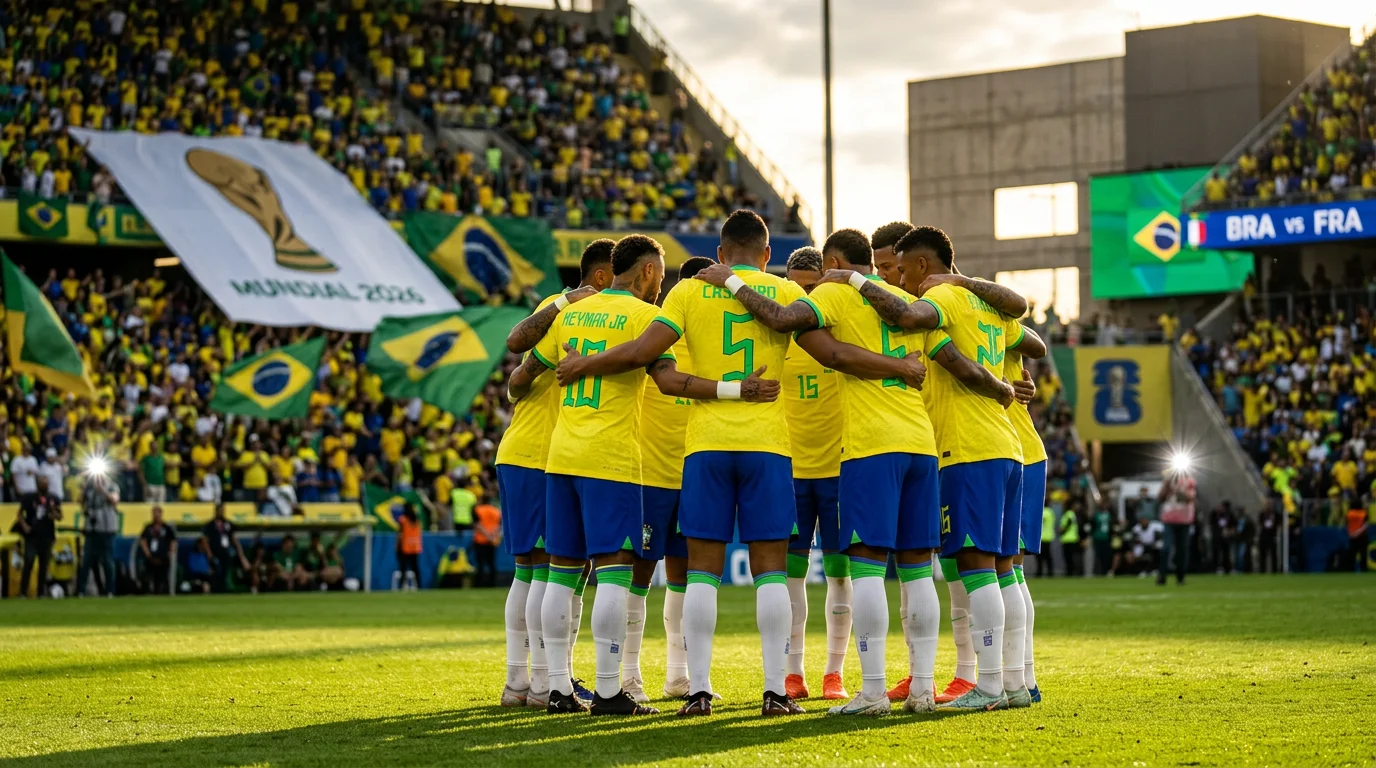
Twenty-four years without lifting the trophy. For any other nation that would be a respectable drought — for Brazil, it is a crisis of identity. The Seleção last won the World Cup in 2002, when Ronaldo scored twice in the final against Germany, and in every tournament since, the five-time champions have fallen short of their own impossible standard. Quarter-final exits, a humiliating 7-1 on home soil, and a series of coaching upheavals have left Brazilian football searching for a formula that reconnects the present squad with the country’s golden legacy. The 2026 World Cup in North America represents the freshest opportunity in a generation: a new coach in Dorival Júnior, a squad blending peak-age European-based talent with hungry young attackers, and a Group C draw that should not trouble the Seleção on paper. Whether that opportunity translates into a genuine title challenge depends on questions only the tournament itself can answer.
For NZ-based punters sizing up the outright market, Brazil remain one of the most heavily backed sides on TAB NZ. The question is not whether Brazil are good — they obviously are. The question is whether their odds represent fair value or whether the weight of the shirt inflates the price beyond what this specific squad deserves.
TL;DR: Brazil Betting Snapshot
- Five-time champions, but winless since 2002 — the longest drought in their history.
- Group C opponents: Morocco, Haiti, Scotland. Brazil should top the group comfortably.
- Key players: Vinicius Junior, Rodrygo, Bruno Guimarães. Depth across every position.
- Outright odds typically sit in the 6.00 to 8.00 range — short enough to reflect genuine contender status, long enough to offer a payout if they peak at the right moment.
- Our angle: Brazil’s value is not in the outright market but in group-stage props and top-scorer side bets where the Seleção’s attacking firepower meets weaker opposition.
Review Brazil’s Road Through CONMEBOL
CONMEBOL qualifying is the hardest route to any World Cup, and Brazil’s campaign proved it. The South American qualification cycle runs across 18 matchdays spread over two years, with every match played at altitude, in tropical heat, or in the hostile away atmospheres of Buenos Aires, Bogota, and Santiago. Brazil stumbled early under their previous coaching regime — defeats in La Paz and Asuncion left them outside the automatic qualification spots at the halfway point, triggering a coaching change that brought Dorival Júnior to the bench.
Dorival’s impact was not immediate. His first few matches in charge produced cautious results: narrow wins at home, hard-fought draws away. But the system gradually took hold. Brazil’s defensive record improved markedly in the second half of qualifying, conceding fewer than a goal per match across the final eight fixtures. The attack found rhythm too, driven by Vinicius Junior’s ability to unlock defences in transition and Rodrygo’s intelligence in tight spaces. By the end of the cycle, Brazil had climbed to a comfortable qualifying position — not table-toppers (Argentina held that distinction), but safely in the top four with games to spare.
The qualifying campaign exposed two concerns that persist heading into the World Cup. First, Brazil’s struggles against deep defensive blocks. Teams that sat in a low block and denied space behind the defensive line — Peru, Venezuela, Ecuador at home — caused Brazil more problems than open, attacking opponents. Group C at the World Cup contains exactly the kind of opponents likely to adopt that approach: Morocco are disciplined defenders, Scotland will sit deep, and even Haiti’s best chance involves compactness. Second, Brazil’s centre-forward position remains unsettled. Dorival has rotated between multiple options without committing to a single starter, and the lack of a guaranteed 15-goal-a-season number nine is the one gap the squad has not convincingly filled.
Assess the Squad and Key Players
Forget the number nine debate for a moment and look at the full picture. Brazil’s squad for the 2026 World Cup is, on paper, one of the three or four deepest in the tournament. Every outfield position except centre-forward has a clear first-choice player performing at the highest level of European club football, with at least one quality backup behind them. That depth is the foundation of any serious title challenge — tournaments are won across seven matches and 630-plus minutes of football, not by a single star performer in a single game.
Vinicius Junior is the headline act. The Real Madrid forward has spent the past three seasons establishing himself as one of the best players in the world, a genuine Ballon d’Or contender whose combination of pace, dribbling, and finishing in big moments is matched by very few active footballers. At 25, Vinicius is entering his physical and technical peak, and the 2026 World Cup arrives at exactly the right point in his career arc. His ability to beat defenders one-on-one, draw fouls in dangerous areas, and score goals from nothing gives Brazil a dimension that most opponents simply cannot neutralise without committing extra bodies to his flank — which opens space for everyone else.
Rodrygo, Vinicius’s club teammate at Real Madrid, operates as the creative connector between midfield and attack. His positional intelligence allows him to drift into pockets of space between the lines, receiving the ball in half-turns and accelerating play forward. Where Vinicius provides explosive directness, Rodrygo provides subtlety and vision. The two complement each other in a way that few international attacking partnerships can match, and Dorival’s system is designed to get both of them on the ball in the final third as frequently as possible.
Bruno Guimarães anchors the midfield. The Newcastle United central midfielder has become one of the Premier League’s most complete midfield players — press-resistant under pressure, capable of switching play with long diagonals, and strong enough in the tackle to win the ball back in dangerous areas. His presence gives Brazil the midfield control they lacked in recent tournaments, where overreliance on attacking flair sometimes left the centre of the pitch exposed. Alongside him, the options are plentiful: Lucas Paquetá brings energy and unpredictability, while younger alternatives from Brazil’s domestic league and European clubs offer different profiles depending on the tactical need.
The defence has been Dorival’s primary project. Marquinhos, now in the twilight of his career but still commanding at centre-back, partners with a younger, quicker option — likely Murillo or Gabriel Magalhaes — to form a pairing that balances experience with athleticism. The full-back positions are stacked with talent. Brazil can field multiple combinations depending on whether the coach prioritises defensive solidity (Danilo, Arana) or attacking width (younger options from the European leagues). The goalkeeper position belongs to Alisson, whose presence alone upgrades Brazil’s defensive reliability by a measurable margin. His shot-stopping, distribution, and command of the penalty area are world-class by any standard.
The squad’s weakness remains the number nine role. Brazil have tried Richarlison, Endrick, and several other options without finding a striker who combines goals, link-up play, and movement at the level the rest of the squad demands. Richarlison’s fitness record is patchy. Endrick’s talent is enormous but his experience is limited — starting a World Cup knockout match at 19 or 20 is a different proposition to scoring in La Liga. Dorival may ultimately solve the problem by playing without a traditional centre-forward entirely, using Rodrygo or Raphinha as a false nine, but that approach has not been stress-tested against elite opposition over a full tournament. It is the one tactical question mark that separates Brazil from Argentina and France in my assessment of genuine title contenders.
Decode Dorival Júnior’s System
If you watched Brazil at the 2022 World Cup under Tite, you saw a team that played beautiful attacking football in the group stage and then ran into a tactical wall in the quarter-finals against Croatia. Dorival inherited the remnants of Tite’s 4-2-3-1 and has gradually reshaped it into something more pragmatic: a 4-3-3 that prioritises midfield control and defensive transitions as much as attacking brilliance. The shift is subtle but significant. Brazil under Dorival are harder to break down, less reliant on moments of individual genius, and more structured in how they move the ball from back to front.
The pressing structure is the most visible change. Dorival’s Brazil press in coordinated waves rather than individual bursts. When the ball is with the opponent’s centre-backs, the front three position themselves to cut off passing lanes into midfield rather than charging the ball. The trigger to press aggressively is a backward or sideways pass into the full-back area — at that point, the nearest wide forward closes down while the midfield shifts across to cut off the switch. This approach conserves energy across 90 minutes and reduces the risk of being caught in transition when the press fails, which was a recurring problem under previous coaches.
In possession, the width comes from full-backs who push high, allowing Vinicius and the right-sided forward to tuck inside and operate in half-spaces. Bruno Guimarães sits at the base of midfield as the primary ball-progressor, receiving from the centre-backs and choosing whether to play short into the attacking midfielders or hit direct passes in behind the opposition’s defensive line. The system is designed to create overloads on the flanks — three-against-two situations where a wide forward, a full-back, and a midfield runner combine to break through — before delivering crosses or cut-backs into the penalty area for the arriving attackers.
The weakness of the system is its dependence on full-back fitness. If either full-back tires or picks up an injury during a match, Brazil’s attacking width collapses, and the team reverts to a narrower shape that is easier for organised defences to contain. Over a seven-match tournament, managing full-back workload will be one of Dorival’s most important decisions.
Break Down Group C — Morocco, Haiti, Scotland
Draw days are supposed to produce drama, but Group C landed with a thud. Brazil were always going to top a group seeded from Pot 1, and the three opponents they received — Morocco, Haiti, Scotland — present a sliding scale of difficulty that starts at “genuine test” and ends at “historic mismatch.” For punters, the group’s predictability is actually useful: it shifts the interesting markets away from “will Brazil qualify?” (yes, obviously) and toward scoreline props, margin-of-victory bets, and player-specific markets where the Seleção’s attacking talent meets limited opposition.
Morocco are the group’s second seed and the only team capable of giving Brazil real problems. The Atlas Lions reached the 2022 World Cup semi-finals with a defence-first approach built on Achraf Hakimi’s overlapping runs, Sofyan Amrabat’s midfield screening, and a centre-back pairing that refused to be beaten aerially. That core is older now but still intact, and Morocco’s coach has maintained the tactical discipline that made them so effective in Qatar. Brazil versus Morocco is a genuine contest — Morocco will sit deep, absorb pressure, and try to exploit transition moments through Hakimi’s pace down the right. I expect a tight, low-scoring match, likely 1-0 or 2-1, and it is the one Group C fixture where Brazil could conceivably drop points.
Haiti’s inclusion is the story of the expanded format. The Caribbean nation qualified through the CONCACAF pathway and arrives at the World Cup as one of the lowest-ranked teams in the tournament. Haiti’s squad is composed primarily of players from the Haitian domestic league and lower-division North American clubs. Their defensive structure is willing but technically limited, and the gap in individual quality between Haiti’s players and Brazil’s squad is vast. This is the match where Brazil’s goal tally could balloon — four or five goals is realistic, and the over/under line will reflect that expectation. For Golden Boot hunters backing a Brazilian forward, the Haiti fixture is the highest-volume goal opportunity in the group.
Scotland return to the World Cup for the first time since 1998, and the Tartan Army will travel in enormous numbers. Emotionally, it is a wonderful story. Tactically, Scotland face the same problem they encountered at Euro 2024: the squad is built to compete in tight, physical matches against teams of similar quality, but against elite attacking sides the defensive line sits too deep and the midfield cannot sustain possession long enough to relieve pressure. John McGinn’s energy and Scott McTominay’s box-to-box running give Scotland a route to goal, but against Brazil’s press and midfield control, chances will be scarce. Brazil should win this match by two or three goals, though Scotland’s stubbornness could keep the scoreline respectable if they defend set pieces well.
The group schedule matters for Brazil’s knockout-round preparation. If the Seleção beat Morocco and Haiti in their first two matches — a likely scenario — they could rotate heavily for the Scotland fixture, resting key players for the Round of 32. That rotation possibility affects how you bet on matchday three: a weakened Brazil side against a desperate Scotland changes the match dynamics entirely.
Evaluate Brazil’s Outright and Group Odds
On TAB NZ, Brazil’s outright World Cup winner odds typically sit between 6.00 and 8.00 decimal — the third or fourth shortest price in the market behind Argentina and France, and roughly level with England. Those odds imply a win probability of 12 to 17 per cent, which feels about right for a team of this quality. Brazil are genuine contenders but not the clear favourites their historical pedigree might suggest. The 24-year trophy drought is not just a narrative — it reflects a structural reality that Brazilian squads have consistently underperformed their talent level at World Cups in the modern era.
The group winner market is where Brazil’s odds become almost unplayable. Expect prices around 1.30 to 1.40 to top Group C, implying a 70-to-75 per cent probability. That is probably fair — Morocco could nick first place with a draw against Brazil and wins elsewhere, but it requires a specific chain of results. Betting on Brazil to top the group returns very little for the risk involved, so I would skip this market entirely unless you are building it into a multi.
Where it gets more interesting is the margins. “Brazil to win Group C with a game to spare” or “Brazil to win all three group matches” are proposition bets that some bookmakers offer for major tournaments. The Seleção’s ability to beat Haiti and Scotland convincingly, combined with a likely win over Morocco, makes the “win all three” market a legitimate play at prices around 2.50 to 3.00. Similarly, Brazil’s total group-stage goals over/under line will be set somewhere around 7.5 — and given the Haiti fixture alone could produce four or five, the over looks attractive.
For NZ punters specifically, comparing Brazil’s odds across different outright-adjacent markets — winner, to reach the final, to reach the semi-finals — reveals where the value concentrates. The “to reach the semi-finals” market at around 2.00 to 2.50 offers a better risk-reward profile than the outright, because it removes the variance of two knockout matches (the semi and the final) while still capturing Brazil’s likely deep run. If you believe Brazil are a top-four team in this tournament — and the squad quality supports that belief — the semi-final market is the smarter entry point.
Find the Value for Brazil Backers
I have a rule when assessing tournament favourites: if the outright price feels “about right,” the value is not there — move to secondary markets. Brazil’s outright odds feel about right. So here is where I am actually putting my money.
First, Vinicius Junior for the Golden Boot. The top-scorer market is notoriously volatile at World Cups — strikers from smaller nations who play extra group matches rarely win it, and the prize almost always goes to a forward from a team that reaches the semi-finals or beyond. Vinicius ticks every box: he plays for a team likely to go deep, he is the primary attacking threat, and Brazil’s group contains Haiti, a fixture that could deliver two or three goals from a single player. His Golden Boot odds on TAB NZ are typically longer than those of Mbappe and Messi, which reflects the market’s uncertainty about whether Dorival will use Vinicius centrally or wide. I think that uncertainty creates mispricing. If Vinicius plays as the inside-left forward with licence to drift into central scoring positions — which is his most productive role at Real Madrid — his goal output will be among the highest in the tournament.
Second, Brazil total tournament goals. The expanded 48-team format means the group stage is longer and the Round of 32 adds an extra knockout match before the quarters. A team that reaches the final plays seven matches instead of the previous format’s seven (because the group stage is the same three matches but the knockout path is one round longer). More matches means more goals, and Brazil’s group opponents include at least one side — Haiti — that will concede heavily. If you can find a “Brazil total tournament goals” market with an over/under line around 12.5, the over is a strong play based on the assumption that the Seleção reach at least the quarter-finals and score freely in the group stage.
Third, the “Brazil to keep a clean sheet in any group match” market, if available, is worth a look at short prices. Alisson in goal, a settled centre-back pairing, and an opponent list that includes Haiti makes at least one shutout highly probable. This is a low-odds, high-probability bet that works well as a leg in a multi alongside other group-stage picks.
What I am avoiding: any market that requires Brazil to win the final. The Seleção’s knockout-round record in recent tournaments — losing to Belgium in 2018, Croatia in 2022 — shows a pattern of faltering in high-pressure elimination matches. Until they prove they can close out a semi-final or final, I am not staking serious money on the outright at current prices. Take the semi-final market instead and let the variance of the final be someone else’s problem.
Make Your Call — Tournament Path Prediction
Brazil will top Group C with seven or nine points, scoring at least eight goals across three matches. The Round of 32 should be comfortable against a third-placed team from a weaker group. The real test begins in the Round of 16 or quarter-finals, where the Seleção will likely face a European side with the defensive structure to frustrate Vinicius and Rodrygo. My prediction is a semi-final appearance — Brazil’s squad depth and attacking talent are good enough to reach the last four, but the centre-forward question and the psychological weight of the 24-year drought will catch up with them in a tight knockout match.
If I had to name the specific exit point, I would say a quarter-final or semi-final defeat to one of Germany, Spain, or the Netherlands — a European side with the midfield quality to control possession and the defensive discipline to limit Brazil’s transition game. The Seleção will play entertaining, attacking football throughout the tournament and leave North America as one of the most watchable sides in the competition. They will not, in my assessment, lift the trophy. But they will come closer than they have in years, and for NZ punters who back them in the right markets — Golden Boot, total goals, semi-final qualification — the returns should be healthy.
