
Build Winning World Cup Multis — NZ Strategy Guide
 Available in US
Loading...
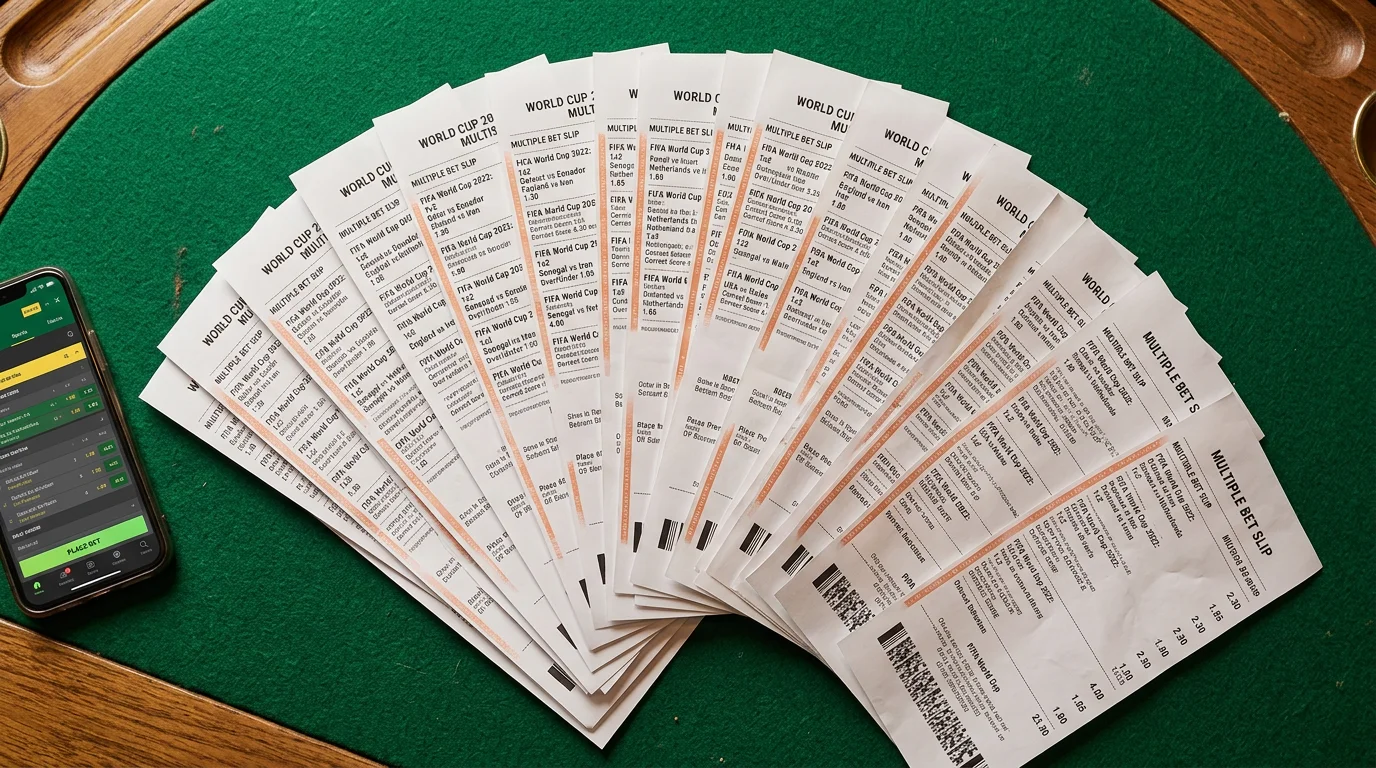
Multis are the national sport of New Zealand punting. I’ve watched mates turn $20 into $800 on a five-leg rugby multi — and I’ve watched those same mates lose $500 chasing the same thrill over the following month. The 2026 World Cup offers 104 matches across 39 days, which means endless multi opportunities and endless ways to donate money to TAB NZ. Here’s how to build accumulators that actually make sense.
TL;DR — Three Rules Before You Build
Save yourself the scroll if you remember these three principles:
- Limit legs to 3-4: Every additional selection halves your probability of landing the bet. Five-leg multis hit about 3% of the time at typical odds.
- Avoid correlated selections: Backing France to win the tournament AND Mbappé to win the Golden Boot isn’t doubling your edge — those outcomes are dependent on each other.
- Use multis for entertainment, not income: The house edge on multis is higher than single bets. Size your stakes accordingly — 0.5-1% of bankroll maximum per multi.
If you follow nothing else, follow those rules. Everything below is elaboration.
Understand What a Multi Is and Why NZ Loves Them
My first ever multi was a three-leg disaster: All Blacks to beat South Africa, Warriors to beat Broncos, Phoenix to beat Sydney FC. All three lost. That was fifteen years ago, and I still remember the slow-motion realisation as each result came through. Multis create emotional engagement that single bets can’t match — which is precisely why they’re dangerous.
A multi (also called accumulator, parlay, or acca) combines multiple selections into a single bet. All selections must win for the bet to pay out. The appeal is mathematical: odds multiply together. Back three teams at 2.00 each, and your combined odds are 8.00. A $10 bet returns $80 instead of the $20 you’d get from a single 2.00 selection.
The probability maths works against you. If each 2.00 selection has a 50% implied chance of landing, your three-leg multi has a 12.5% chance (0.5 × 0.5 × 0.5). TAB NZ prices that at 8.00 odds, implying 12.5% — but you’re accepting all-or-nothing risk. One bad pick erases everything. Singles let you go 2-1 and still profit; multis don’t.
NZ punters love multis because they’re culturally embedded. TAB NZ has promoted accumulators for decades, particularly around rugby. The “Bonus Multi” offers enhanced odds if you add legs, incentivising bigger bets. The marketing works — multis generate higher margins for operators than any other bet type. That’s not conspiracy; it’s disclosed accounting.
Despite the maths, multis have legitimate uses. They let you turn small stakes into meaningful returns. They create entertainment value across multiple matches. They reward conviction — if you’ve genuinely analysed three outcomes and believe each is mispriced, combining them amplifies your edge. The key is discipline: small stakes, limited legs, understood risks.
Build a World Cup Multi on TAB NZ — Step by Step
The process is straightforward, but the details matter. Here’s the literal walkthrough for placing a World Cup multi on TAB NZ.
Step one: navigate to football markets. Log into your TAB NZ account (or create one if you haven’t). Select “Football” from the sports menu, then “FIFA World Cup 2026.” You’ll see categories: outright markets (tournament winner, Golden Boot), group-stage betting, and match betting. Multi building works across all categories.
Step two: select your first leg. Click on any outcome to add it to your betslip. For example, click “France” in the 1X2 market for France versus Senegal. The selection appears in your betslip with individual odds displayed. This is your first multi leg.
Step three: add additional legs. Navigate to another market and select another outcome. Click “Argentina” in Argentina versus Algeria. Your betslip now shows two selections, and the combined odds update automatically. Repeat for each leg you want to add. TAB NZ allows up to 20 legs in a single multi, though anything beyond five is statistically masochistic.
Step four: enter your stake. Below the selections, enter the amount you want to bet. TAB NZ shows your potential return based on combined odds. A $10 stake at 6.50 combined odds returns $65 (including your stake). Double-check the maths matches your expectations.
Step five: confirm and place. Review all selections, confirm your stake, and place the bet. You’ll receive a confirmation number. The multi is now live — all legs must win for you to collect.
Same-game multis: TAB NZ offers same-game multis on individual World Cup matches. You can combine 1X2, BTTS, and Over/Under within a single game. The platform calculates adjusted odds to account for correlation (backing France to win and Over 2.5 Goals aren’t fully independent). Same-game multis are useful for high-conviction blowout scenarios where you expect multiple related outcomes.
Apply Three Proven Multi Strategies for Tournaments
Tournament football differs from league football. Teams play every 4-5 days instead of weekly. Fatigue accumulates. Motivation shifts based on qualification scenarios. These dynamics create specific multi strategies worth considering.
Strategy one: favourite parlay with built-in protection. Backing three group-stage favourites feels safe — until one slips against a motivated underdog. The protection approach adds a fourth “insurance” leg at short odds that shifts combined odds slightly while reducing catastrophic loss probability. Example: France at 1.30, Brazil at 1.35, England at 1.45, and Netherlands at 1.25. Combined odds around 2.95. If any favourite stumbles, you lose everything — but the fourth leg means you’re not ruined by a single upset.
This strategy works best in early group stages before fatigue and complacency set in. Avoid it in matchday three when qualified teams rest players.
Strategy two: BTTS multi across attacking matchups. Both Teams To Score markets offer lower variance than 1X2 because you’re removing result dependency. Identify three matches where both teams need results and have attacking quality: Group I (France vs Norway — both will attack), Group C (Brazil vs Morocco — open game), Group L (England vs Croatia — historically tight). BTTS “Yes” in all three might price around 4.00-5.00 combined. You need both teams to score in each match, but you don’t care who wins.
The risk: one defensive stalemate kills the multi. Avoid BTTS when one team can qualify with a draw and will sit deep. Matchday two often produces conservative tactics.
Strategy three: cross-tournament value pick. This is the advanced play. Combine one outright market (Portugal to reach semi-finals at 2.50) with a group-stage outcome (Portugal to top Group K at 1.70). Combined odds around 4.25. The selections are correlated — Portugal reaching the semis probably means they topped their group — but the odds don’t fully reflect that dependency. You’re betting on a single team scenario across multiple markets.
This strategy requires genuine analysis. You need to believe Portugal is undervalued in both markets independently. If you’re guessing, you’re gambling; if you’ve analysed their squad, group, and bracket path, you’re investing.
Avoid the Multi Traps That Drain Bankrolls
Every experienced punter has a cautionary multi tale. Mine involves a six-leg accumulator at the 2014 World Cup that died on Netherlands versus Spain — a match I added “for safety” because Spain were defending champions. Netherlands won 5-1. The perceived safe leg was the trap.
Trap one: adding legs to hit a target payout. You build a three-leg multi at 5.00 odds, but you want a $500 payout from a $50 stake. So you add a fourth leg to push odds to 10.00. That fourth leg wasn’t part of your original analysis — it’s filler. Filler legs lose. If your genuine analysis supports three legs, bet three legs at appropriate stakes. Don’t dilute conviction for payout dreams.
Trap two: over-reliance on favourites. Backing five 1.20 favourites feels “safe” but offers combined odds of only 2.50 and requires all five to win. One upset — which happens roughly 20% of the time at 1.20 — kills everything. You’re accepting significant risk for moderate reward. Either back fewer legs at higher individual odds, or accept that favourite multis are low-EV entertainment.
Trap three: ignoring correlation. Backing Brazil to win the tournament and Vinícius to win the Golden Boot isn’t a true multi — those outcomes are heavily correlated. If Brazil wins, Vinícius likely scored the goals that got them there. The combined odds should reflect that dependency, but operators don’t always adjust correctly. You think you’re getting multiplicative value; you’re actually getting correlated odds. Identify correlation before building.
Trap four: chasing losses with bigger multis. You’ve lost three straight multis totalling $100. The temptation: build a four-leg at 15.00 to recover with one bet. This is bankroll suicide. Losing streaks are normal in multi betting because hit rates are inherently low. Chasing accelerates losses. Stick to consistent stakes regardless of recent results.
Trap five: emotional legs. Adding the All Whites to your multi because you’re Kiwi and want them to succeed isn’t analysis — it’s sentiment. Emotional legs cloud judgment. If you want to bet on New Zealand for patriotic reasons, place a separate single. Keep your multi analytical.
Walk Through a Sample World Cup Multi
Theory is useful; application is better. Here’s a worked example of building a World Cup multi with the strategies above.
The scenario: Matchday one of Group G. Belgium versus Egypt kicks off at 18:00 ET, followed by Iran versus New Zealand at 21:00 ET. You’ve analysed both matches and identified two genuine betting positions. You want to combine them into a multi with a third leg from elsewhere in the schedule.
Leg one: Belgium to beat Egypt at 1.55. Belgium is ageing but still superior to Egypt on paper. Egypt relies heavily on Mohamed Salah, who can be isolated by compact defences. Belgium at home (effectively — playing in Seattle, but listed as the “home” team) should control the match. Edge: Belgium’s experience in tournament openers.
Leg two: Iran versus New Zealand Under 2.5 Goals at 1.75. Both teams are underdogs in the group. Both will approach this opener cautiously — a draw serves neither side’s qualification hopes, but a loss is catastrophic. Iran defends deep; New Zealand won’t dominate possession. This smells like a 1-0 or 1-1 grind. Edge: defensive mindsets from both sides.
Leg three: France to beat Senegal at 1.35. France is the tournament favourite playing their first group match. Deschamps always starts tournaments conservatively but effectively. Senegal has quality but lacks the depth to compete over 90 minutes against Les Bleus. This is a “banker” addition at short odds to boost combined returns without excessive risk. Edge: France’s tournament pedigree.
Combined odds: 1.55 × 1.75 × 1.35 = 3.66. A $20 stake returns $73.20 if all three legs land.
Analysis check: Are the legs correlated? Belgium’s result doesn’t affect Iran versus New Zealand or France versus Senegal — different groups, different matches. The legs are independent. Is any leg filler? All three came from genuine analysis rather than chasing odds. The multi passes the discipline test.
Stake allocation: At 3.66 odds, this multi has roughly a 25-30% chance of landing (assuming slight value in each leg). A $20 stake represents 1% of a $2,000 World Cup bankroll — appropriate sizing for accumulator risk.
When Multis Work — and When They Don’t
Multis aren’t inherently good or bad. They’re tools with specific applications. Knowing when to use them — and when to stick with singles — separates profitable punters from frustrated ones.
Multis work when: you have genuine analytical edge on multiple independent outcomes and want to compound that edge. You’re betting for entertainment with stakes you can afford to lose entirely. You’ve identified inefficiencies across markets that don’t affect each other. You understand that hit rates will be low and accept variance.
Multis don’t work when: you’re building them to chase higher payouts without corresponding analysis. You’re adding legs to recover losses. You’re treating them as “investment” rather than entertainment. You’re combining correlated outcomes without adjusting expectations.
The 2026 World Cup offers 104 matches across 39 days. That’s enough content for thousands of potential multis. Most of them will lose — that’s mathematical reality. The winners are the punters who build selectively, size appropriately, and remember that entertainment value counts even when the betslip doesn’t cash.
For more on setting up your TAB NZ account and managing tournament bankrolls, the beginner’s guide covers the fundamentals.
